


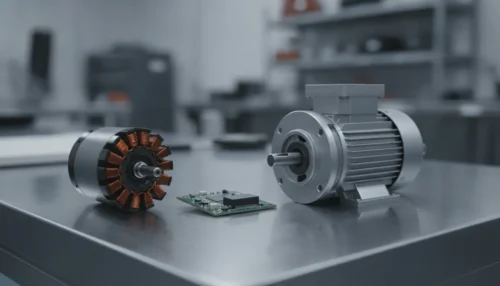
A brushless vs brushed motor decision is a commutation choice, not a brand preference. One motor switches current with brushes on a spinning commutator. The other switches current in a fixed stator with electronics. That split sets service life, noise, speed, and how much control hardware the machine must carry.
Call (813) 468-3036 about your motor requirements.
For a one-off lab setup, a brushed motor can be the shorter path because a DC supply is enough to make it turn. For an OEM product that must run for years in heat, moisture, or repeated sterilization, the brush is often the part that fails first. Composite Motors builds custom brushless AC and DC motors, and the controllers that commutate them, for those programs. The families are listed on the benefits of custom electric motors.
The sections below walk through how each machine makes torque, what the controller adds, and which facts to settle before you pick a topology.
What changes in a brushless vs brushed motor
Both machines turn electrical power into shaft torque. The difference is where the switching happens.
In a brushed DC motor, permanent magnets usually sit in the housing and the windings sit on the rotor. Carbon brushes ride on a commutator fixed to the shaft. As the shaft turns, the brushes hand current to the next coil. A constant DC voltage is enough to run the simplest form, which is why these motors still show up on benches and in simple actuators. A 2016 Ghent University comparison of motors under 1.5 kW describes that simple drive as the reason a brushed machine can still be the right pick. It also names brush and commutator wear as the life limit, and notes that higher speed makes that wear worse. The paper is A quantitative comparison between BLDC, PMSM, brushed DC and stepping motor technologies.
A brushless motor reverses that layout. Permanent magnets are on the rotor. The windings are on the stator and do not move. Nothing slides across a commutator to pick the next coil. An electronic controller energizes the stator phases in sequence so the magnetic field keeps pulling the rotor around. Hall sensors, or a sensorless estimate of rotor position, tell the controller when to switch. Without that sequence, the rotor sits still or twitches. It does not run as a motor.
Composite Motors describes the same layout on its custom brushless DC motors page: magnets on the rotor, electromagnets on the stator, and electronics that step the field through a full revolution. That page is the product family. This article is the selection logic that comes before a design review.
Two names get mixed together in sourcing notes. A brushless DC motor is usually driven with currents that look closer to square waves, switched in coarse steps. A permanent-magnet synchronous motor is the same broad family, driven with currents shaped like sine waves for smoother torque. The Ghent survey treats them as related but not identical, and it finds the sine-wave machine ahead on torque density in that sample. For an OEM spec, say which current shape you expect. “Brushless” alone does not tell a builder how the controller should behave.
Where the controller fits
The brush is a mechanical switch. Remove it, and the switch has to live on a circuit board.
A brushed motor can start from a DC source and a switch. Speed often comes from changing the average voltage. Direction comes from swapping the leads. Fancier drives exist, but they are optional. That is the practical case for a fixture, a short-life tool, or a prototype that only has to prove a mechanism.
A brushless motor does not have that option. The controller is part of the motor system. It must know rotor position, switch the phases in order, and limit current so a stall does not cook the windings. Sensored control uses Hall devices or another position signal. Sensorless control infers position from the windings, which can simplify the harness but usually needs a defined start routine. Either way, someone has to design, program, and test that board against the motor it will drive.
That pairing is where custom programs usually spend their time. A motor wound for one voltage and pole count will not behave on a controller tuned for another. Composite Motors builds custom BLDC controllers for speed, torque, and direction, including boards that are later sealed with the motor. If the controller itself is the open design problem, the separate guide on designing a controller for a brushless DC motor is the right next read. This article only needs the yes-or-no: if you cannot put a controller in the product, a brushless motor is the wrong topology.
Ask three control questions before you fall in love with a catalog curve:
- Does the product already have a drive, or must the motor bring one?
- Is the duty mostly on or off, or does the shaft need held speed and limited torque?
- Can the harness carry sensor wires, or must commutation be sensorless?
How duty, environment, and service decide it
Catalog language says brushless motors are more efficient and last longer. That can be true, and it can also hide the real constraint. Match the topology to the life of the machine, not to a slogan.
Brush wear is a maintenance item. Someone has to reach the motor, or the motor has to be cheap enough to replace. Sealed housings, autoclaves, gearboxes full of grease, and installed equipment in the field all make brush service expensive. If the shaft also turns fast for long periods, the commutator is doing that work on a small contact patch. The Ghent study points to brushless machines for high-speed continuous jobs such as compressors, pumps, and ventilation, for that reason. Those are findings about the technologies in their sample, not a rating of any one builder’s motor.
Brushed motors still earn their place. The drive can be a supply and a relay. Peak torque is available from a simple current, and some designs tolerate short overloads well. If the product runs a few minutes a day, lives in a clean enclosure. And will be serviced on a schedule, the brush may never be the thing that fails. Paying for a three-phase inverter to avoid a part you can reach is not automatic engineering.
Environment is the other filter. Carbon dust from brushes is a contaminant. Sliding contacts also make electrical noise that can bother nearby sensors. A wet, salt, vacuum, or repeated-sterilization environment attacks both the contact and the lubricant in the bearings. Brushless construction removes the sliding contact, but it does not by itself survive an autoclave or saltwater. The housing, seals, magnet grade, insulation, and controller potting still have to be chosen for that environment. Composite Motors designs motors and hermetic controller packages for harsh-environment work, including industrial machinery, defense and aerospace equipment, marine duties, and devices that see sterilization. A critical-application or veterinary tool is one of those cases, not a separate kind of motor.
Use this pass before you request a proposal. It is a filter, not a sizing method.
| Question to settle. | Points toward a brushed motor. | Points toward a brushless motor. |
|---|---|---|
| How the shaft is powered. | A DC source and a simple switch are acceptable. | The product can carry a commutation controller. |
| Speed and duty. | Moderate speed, or short intermittent runs. | High speed, or long continuous runs. |
| Service access. | Brushes can be inspected, or the unit replaced. | The motor is sealed, buried, or not serviced. |
| Environment. | A clean, dry enclosure with a known service plan. | Heat, moisture, vacuum, salt, or sterilization. |
| Control quality. | On and off, or coarse voltage control, is enough. | Held speed, a torque limit, or quiet torque matters. |
| Electrical noise. | Nearby electronics can tolerate brush noise. | Sensors or radios need lower commutation noise. |
Read the table as a pattern, not a score. Two strong brushless columns do not cancel a hard limit, such as no room for a controller. One harsh environment does not cancel a brushed motor that is replaced every service interval on purpose.
What to send before anyone sizes a motor
Topology is the first fork. Sizing is the next, and it needs numbers from the machine, not adjectives.
Write the operating point the way a test stand would see it. State the torque at the shaft, the speed, and how long each lasts. A ten-second peak and a continuous cruise are different motors. Note the voltage the system can actually hold under load, not the nameplate of the battery at rest. Note the duty cycle across a minute, an hour, and a shift.
Then write the constraints that change construction:
- Envelope: diameter, length, shaft, and what the flange mounts to.
- Environment: temperature, water, salt, vacuum, vibration, and any sterilization method.
- Life: operating hours, cycles, and whether the motor is serviced or sealed for life.
- Control: sensor wires or sensorless, speed loop or torque loop, and faults the controller must report.
- Build path: ground-up design, a change to an existing design, or build-to-print from your drawings.
Leave ratings, price, and lead time off the first note. A responsible builder will not promise those until the duty and the environment are real. Composite Motors publishes custom brushless and permanent-magnet motors, built-to-print AC motors, and matched controllers on that products overview. All of those products are made in the United States, at the Brooksville, Florida plant. That is a sourcing fact. It is not a performance rating.
A short primer on why teams define a brushless DC motor in the first place sits at Importance of defining brushless DC motors. Use it as background. Use the list above when you are ready to ask for a design.
Mistakes that lock in the wrong topology
The expensive errors are decisions that look small on a spreadsheet.
Treating brushless as always better is the first. If the controller does not fit the board stack, or the firmware team cannot own commutation, the brushless motor never ships. A brushed motor with a planned brush interval can be the honest design.
Copying a catalog efficiency number into a spec is the second. Efficiency depends on the winding, the speed, the load, and the controller. A figure from someone else’s motor, or from a paper about a different sample, is not your motor. Ask for the curve at your duty point after the electromagnetic design exists.
Ignoring the controller as a wear item is the third. Brushes wear in the open. Electronics wear by heat, moisture, and voltage spikes. A brushless program that seals the motor and leaves the drive unprotected has only moved the failure. If the controller must see the same autoclave, salt fog, or vacuum as the motor, say so at the start. Hermetic packaging is a design scope, not a sticker added at the end.
Skipping the build path is the fourth. Reverse engineering a legacy brushed motor into a brushless drop-in is a different job from a clean-sheet design. The shaft, the voltage, and the connector may be fixed by the machine you already ship. State which of those are frozen.
Frequently asked questions
Can a brushless motor run without a controller?
No. A brushless motor has no commutator, so something else must switch the stator phases in order. That something is a controller using a position sensor or a sensorless estimate. A DC supply alone will not make it run.
Is a brushed motor still a valid OEM choice?
Yes, when the drive must stay simple and someone can service or replace the brushes. Short duty, moderate speed, and a clean enclosure favor that choice. Long continuous runs at high speed, or a sealed harsh environment, usually favor brushless construction instead.
Does brushless always last longer?
It removes brush and commutator wear, which is the classic life limit on a brushed motor. Bearings, insulation, magnets, and the controller can still set the life. Ask for life at your speed, load, and temperature, not a universal hour figure.
What is the difference between a brushless DC motor and a permanent-magnet synchronous motor?
Both put magnets on the rotor and windings on the stator. The usual split is the current shape. Brushless DC drives often use stepped, flatter currents. Permanent-magnet synchronous drives use sine-shaped currents for smoother torque. The controller design follows that choice.
What should we send Composite Motors first?
Send torque, speed, duty cycle, voltage under load, envelope, environment, and whether you need a matched controller. Say if the work is a new design, a revision, or build-to-print. Do not send a target price in place of those facts.
Tell us about your project
If the table above points to a brushless motor, the next step is a duty-point conversation, not a catalog guess. Composite Motors designs and builds custom brushless AC and DC motors and motor controllers in Brooksville, Florida, including sealed controller packages when the environment demands them.
Call (813) 468-3036 to tell us about your project.
You can also use the contact form. The Brooksville plant lists (352) 799-2599 on the contact page, weekdays from 8:00 a.m. to 4:30 p.m. Eastern. Include the torque, speed, and environment if you have them. Let’s start your project from the operating point, not from a generic frame size.