


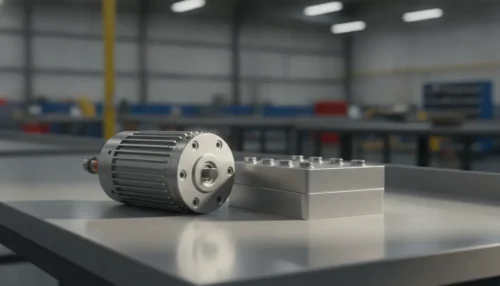
Autoclavable Motors are motors specified against a named sterilization cycle, not motors that merely look sealed. Start with steam temperature, pressure, time, and cycle count, then check seals and electronics. A rating on one datasheet does not travel to every motor. Composite Motors in Brooksville, Florida builds custom brushless AC and DC motors and hermetic packages on American soil. The medical devices page is the integration review, not a cycle rating.
Tell us about your project. Send the sterilization cycle and package limits so engineering can review the application before writing the formal project quote.
What an Autoclavable Motor Actually Means
Steam sterilization uses saturated steam under pressure. The U.S. Centers for Disease Control and Prevention names four parameters: steam, pressure, temperature, and time. Two common steam-sterilizing temperatures are 121°C (250°F) and 132°C (270°F). A recognized minimum for wrapped healthcare supplies is 30 minutes at 121°C in a gravity-displacement sterilizer, or 4 minutes at 132°C in a prevacuum sterilizer. Those figures describe a healthcare sterilization process. They are not a motor rating. The same overview says time at a constant temperature depends on the item being processed, the wrap around it, and the sterilizer type. A metal handpiece and a wrapped porous pack are not the same load. Pressure, in that guidance, is the means of reaching the required temperature. It is not separate proof that a motor seal will hold.
A motor becomes autoclavable only when a named configuration and revision is specified against a named cycle. The live custom BLDC controllers page makes that boundary explicit. It points readers to configuration data sheets and says to confirm compatibility, current specifications, and validation requirements for the design. It does not publish one cycle that every motor survives. Two published examples show how narrow the claim is. On the CMI-8048-04 sheet, both the surgical hand-tool motor and the electronics are autoclavable. The CMI-6090-05 sheet describes a battery-powered equine dental-float application that is autoclavable, with components tested to withstand harsh environments. Neither sheet is proof that a different motor, a different driver, or a different instrument can use the same cycle. Send the instrument’s actual cycle. Do not copy a general table onto a motor specification and call the motor qualified.
Collect the Cycle Before You Collect the Motor
Purchasing and engineering should agree on the cycle before they compare motors. A useful request names the facts the supplier can design against. Finished-device validation stays with the instrument maker. IPX8 conditions are agreed by the manufacturer and the user, and they are not a steam-cycle specification. The About page lists IP68-rated, autoclavable, sensored, and temperature extremes in one feature line. Those words are not one test. A feature list is not a datasheet.
| Fact to collect | Why it belongs in the request | What not to assume |
|---|---|---|
| Sterilizer type and cycle | Gravity displacement and prevacuum cycles heat a load differently. CDC treats time and temperature as a pair. | That 121°C for 30 minutes and 132°C for 4 minutes are interchangeable for a motor. |
| Temperature, pressure, exposure, and dry time | Steam, pressure, temperature, and time are the four parameters CDC names. Repeated heat and moisture are the design input. | That a seal rating, an ingress rating, or one cycle is a steam-life claim. |
| What is in the chamber | Motor only, motor plus driver, or a complete handpiece changes the seals and the heat path. | That “electronics autoclavable” on one sheet applies to a different controller. |
| Who validates the finished device | The instrument maker owns finished-device sterilization validation. The motor supplier owns the configuration it quotes. | That a motor datasheet is a device clearance or a surgical-suitability test. |
Review the Motor, the Seals, and the Controller Together
An autoclave cycle attacks the places steam can enter and the places heat can sit. For a custom program, Composite Motors can scope a brushless motor and its controller as one assembly. The live motors and controllers page describes that review. It covers interface, packaging, thermal and environmental conditions, and the equipment’s motion, load, speed, and torque. It does not publish a standard bundle or a fixed specification.
Use that page as the integration checklist, then add the sterilization facts it does not list. Name the seals at the shaft exits, connectors, and housing joints. Name the materials that see the cycle temperature, not only the running temperature. Say whether the driver enters the chamber. Do not assume a glass-to-metal seal, a gasket, or an over-molded joint unless the written quote names it.
When hermetic packaging is in scope, the hermetically sealed devices page covers thermal-expansion mismatch, specialty alloys, and glass seals. It states the process can achieve MIL-STD-883 Method 1014, a seal test for microelectronic devices, not a surgical test and not a steam cycle. The engineering and manufacturing services page lists custom design, build-to-print, winding, over-molding, machining, assembly, and testing. Reverse engineering does not skip the cycle or remove the need for a prior supplier’s name. Over-molding alone is not an autoclave seal.
Quiet operation and reduced electromagnetic interference are separate points on the motors and controllers page. Quiet operation means the controllers help brushless motors run without generating noise. Reduced EMI is attributed to enclosed internal components. Do not join those two points with a causal claim, and do not treat either point as an autoclave rating.
Let’s start your project. Share the cycle, the envelope, and whether the driver is in the chamber through the contact page before the design work starts.
Read a Rating Only on the Sheet That States It
One document states an autoclave figure, and it must stay there. The CMI-8112-04 sheet, MKT-00010 Rev A, dated June 17, 2020, describes a hermetically packaged DC motor controller. Specifications are subject to change. Consult the factory for current ranges. Do not copy the 134°C line onto CMI-8048-04 or CMI-6090-05. On CMI-8112-04, the operating range and the Class B autoclave line are different rows. Keep them separate in a quote.
| Item on CMI-8112-04 | What that sheet states | How to use the figure |
|---|---|---|
| Package | Hermetically packaged DC motor controller. Drivers are hermetically sealed. | Applies to this sheet’s unit, not to a different controller. |
| Autoclave statement | The entire unit is Class B autoclavable at 134°C. | Not a current general capability of every Composite Motors motor or controller. |
| Supply and current | 8 to 24 VDC. Peak output current is 80 A. Peak limit protection is set to 60 A. | Keep 80 A and 60 A separate. Neither figure is motor phase current. |
| Operating range | -20°C to +125°C. | Not the steam cycle. The autoclave line is separate. |
| Hermeticity | Leak rate of 1.0 x 10⁻⁷ atm-cc/sec helium maximum. | A leak-rate figure, not a steam-cycle specification. |
Ask for the voltage window, the peak current, and the torque-speed point as three separate facts. Public pages do not tie a sagging supply voltage to a higher current at the same torque, so this article does not either. The medical and veterinary page already points readers at torque-speed for the CMI-8048-09 surgical hand-tool sheet. That is the right shape of question. It is not a published number for an unnamed motor.
Duty also belongs in the request. A short stall, a repeated start, and a long run at one speed heat the winding differently. Composite Motors does not publish a sitewide rule that an electronic drive limits current or stops on a stall. If the instrument needs that behavior, name it as a requirement and ask whether the quoted controller provides it. The About page lists sensored among motor features. It does not say every motor includes Hall sensors, and it does not say what a drive does if a sensor signal is lost. Ask for the named drive’s own fault documentation. A third-party controller note is not Composite Motors behavior.
Put the Open Items on the Quote
A useful quote request carries the cycle and the boundaries. It does not ask the supplier to invent a life, a price, or a lead time. Products are made on American soil in Brooksville, Florida. That sourcing fact is not a sterilization rating. A team can bring a build-to-print package, start a custom design, or ask whether a named sheet is a starting point. None of those paths publishes cycle life, a tooling charge, or an annual quantity.
- Name the instrument class in general terms, such as a surgical hand tool. Do not include customer or project names.
- State the sterilizer type, temperature, pressure, exposure time, dry time, and the cycle count the instrument must survive.
- State whether the motor, the driver, or both enter the chamber. Give the envelope, shaft, connector limits, and which seals the quote covers.
- Attach any existing drawing or data sheet. Say whether the path is custom design or build-to-print.
- Ask which configuration and revision the quote covers, and which figures it does not publish, including voltage, current, and torque.
- Keep finished-device sterilization validation, biocompatibility, and regulatory submission with the device maker.
Leave cycle life, a comparative failure rate, price, lead time, a minimum order, shipping territory, and any customer name off the public page. Do not claim the customer keeps the electromagnetic design unless the quote says so. A shorter cable is not a documented way to make an axis respond faster. The process reference is the CDC page Steam Sterilization in the 2008 healthcare guideline. Use the named sheet for the motor or controller.
For how to compare builders on process, see how OEMs evaluate electric motor manufacturers. For later test steps, see electric motor testing methods. Neither article owns the autoclave question. Electrical testing is not a substitute for the instrument maker’s sterilization validation.
Call us about your needs. Tell us about your project through the contact page so engineering can review a sterilization cycle, a package envelope, and whether the path is custom design or build-to-print.
Frequently Asked Questions
Are All Composite Motors Products Autoclavable?
No. The About page lists autoclavable among motor features. Published autoclave statements sit on named data sheets, including CMI-8112-04, CMI-8048-04, and CMI-6090-05. Confirm the configuration and revision for your cycle.
Does 134°C Apply to Every Autoclavable Motor?
No. 134°C is the Class B autoclave statement on the CMI-8112-04 sheet, MKT-00010 Rev A, dated June 17, 2020. It is not a standing rating for other motors or controllers.
Is MIL-STD-883 Method 1014 an Autoclave Test?
No. The hermetic-devices page cites Method 1014 as a seal requirement for the electronics package. It is a seal test for microelectronic devices, not a steam cycle and not a test of surgical suitability.
Can a Build-to-Print Package Include an Autoclave Requirement?
Yes. Send the cycle with the drawing. Build-to-print support reviews an existing design for manufacture. It does not add a sterilization rating the drawing does not state.
Who Validates That the Finished Instrument Is Sterile?
The device maker validates the finished instrument. Composite Motors can design, build, and test the quoted motor or controller configuration. That work is not device clearance.